
In the last chapter we learnt that there is a formula for helping pain subside, which goes like this:
Pain SUBSIDES when the brain concludes there is more credible evidence of SAFETY related to the body than credible evidence of DANGER related to the body.
So let’s start looking at this evidence and try to make it personal to you.
Unlike acute pain, Chronic, or Persistent Pain as I like to call it, is somewhat challenging to understand when it comes to “Evidence”.
For example, by the time people come to me, they’ve often been in pain for many months, and often many years, and by this time practically everything represents danger, and their world has become very small indeed. The only really clear “evidence” is that this pain isn’t going anywhere.
So I often think it’s best to forget about trying to make sense of the past, or even why the pain is there in the first place, and just ask the Cave Person inside what they need us to understand now, today, about it’s sense of safety related to your body.
To do that, let’s have a go at putting down the Cave Person’s thoughts on paper.
The Protectometer.
Here’s a useful little exercise to explore the thoughts and feelings of your own Cave Person and how it’s trying to protect you.
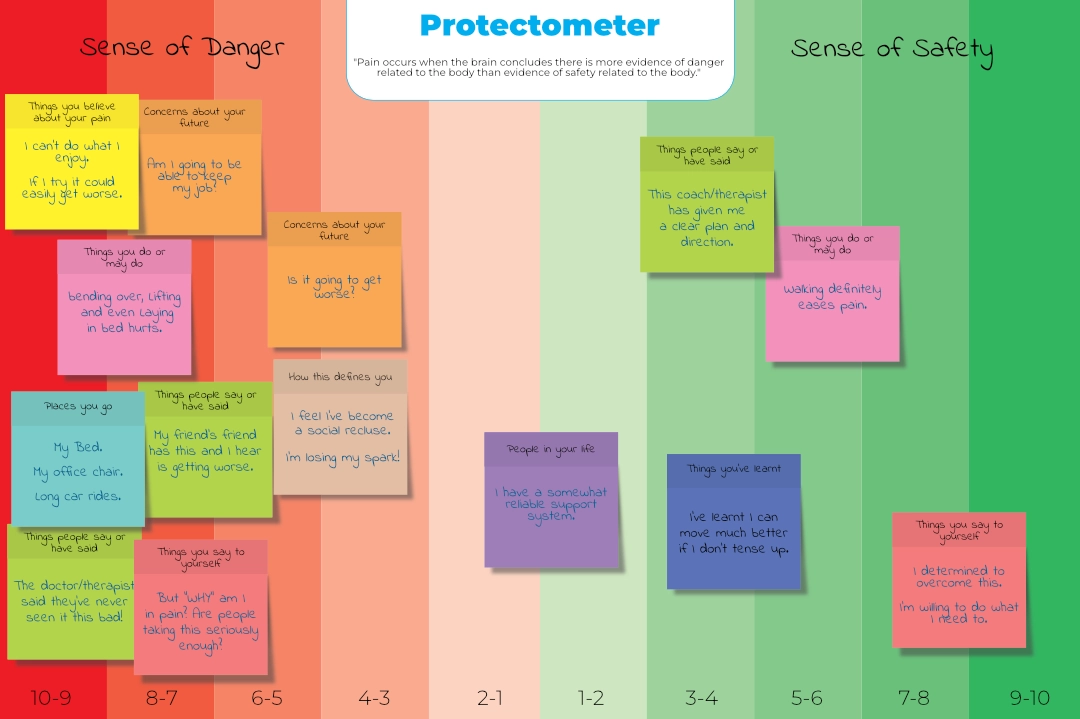
In the image below we have a play board that goes from 10/10 ” Sense of Danger” in deep red on the left, over to 10/10 “Sense of Safety” in deep green on the right.
Your job is to look at the various areas of your life, in relation to your pain, and write down your worries, concerns and even victories, and write them all on Sticky-Notes.
Once you have a Sticky-Note, you place it where you feel it should go, from something that intensely concerns you, to something that truly supports you.
There should be no judgement here in terms of what others might think. For example, you may place a note that say’s “I’m concerned this will get worse” in the red 9-10 zone, but everyone you speak to says it won’t, even your orthopaedic surgeon. To put it bluntly –– what they think doesn’t matter! This is all about what you think. Or more accurately, what your Cave Person thinks.
Here’s an example of some thoughts spread across the play board. Some in the red zone and some in the green representing the level of concern this person has for them.
Download a free worksheet here.
As you can see here, the evidence is currently weighted towards the “danger” side of the play board. But it’s also important to note down the low scores and the good scores too.
Some people find it hard to place anything at all on the green ‘safety’ side, and that’s okay, you don’t have to. It’s best to be honest because you can’t fool the Cave Person –– he/she/they live in a part of your brain that doesn’t even register your conscious brain’s tendencies for denial!
The Goal.
The goal over time, when working with a doctor, therapist or pain coach, is to move the sticky-notes from the red side to the green, by addressing those fears –– as crazy as some of them might sound.
Eventually you’ll scrunch up the old sticky-notes and replace them with a statement that conveys safety in that area.
For example, the movements that concern you now should be worked on until they feel safe. As you gain confidence you move the note from 9/10 across to 6, then 4, then 1 and then scrunch up the note and write a new one that says something like “bending and lifting are free flowing for me now, Whoopee!!”, and start moving that not across the green side.
Okay, so with that in mind, what should we write on our sticky-notes?
Time To Get Writing?
You’ll see in the example at the top of each sticky-note is a heading. These are designed to have you think about various areas of your life that can impact your pain. These headings include:
- Things you believe about your pain (what you believe to be true about your situation)
- Concerns about the future (from progression of pain, to the impact on your wider life)
- Things you do or may do (that impact pain)
- Things people say or have said to you (about your condition)
- Places you go (that trigger/support you)
- Things you say to yourself (positive or negative)
- People in your life (your support systems, or lack of)
- How this defines you (losing/becoming who you are)
- Things you have learnt (that cause/ease pain)
Try to write at least one sticky-note for each category. Remember, you can write safety evidence too, so if a category feels well managed to you, then write down why and place it on the board. The ultimate goal is to focus your mind on all the evidence of safety in order to help pain subside, so you may as well get started placing notes on that side –– you may realise you have more reason to hope than you thought!
The categories are just to help you search your mind for your concerns so you don’t have to stick to these headings, or even write them on the note. Most people find that once they get started writing the concerns come flooding out regardless.
Then What?
When you’re done filling up the board you simply pick one to two concerns that you want to address, then seek evidence that moves the note across the board.
Some you can move yourself just by questioning whether the concern is valid or not. For example, if you wrote, “I’m ALWAYS in pain” but then you really pay attention for a few days and realise that the pain ebbs and flows, then you could change the note to read, “my pain ebbs and flows, which means it has good moments”. In doing so you might feel you could move the concern across the board.
Other concerns you can also deal with by asking others the right questions. For example, if a note suggests you don’t really understand your scan results, then go ask someone to clarify the them for you. Doctors have a habit of assuming you understand what they’ve said, just because the dumbed down the medical jargon –– a bit! Yet I speak with people all the time about their reports and they had no idea how encouraging the results actually were.
Other areas of concern are going to require you to find help. We’ll talk about this in the next chapter but for now just remember, the doctor, therapist, coach wants to help you. So share these notes with them and ask them to help you find the safety you need.
Okay, Let’s Round This Lesson Up.
This lesson was all about bringing awareness to the worries and concerns that drive your pain.
In acute pain these concerns are largely localised to the tissues and doing the right process to heal them.
In persistent pain, these concerns can become wide ranging and increasingly worrisome because they’re not resolving. Because of this we can build up a large evidence base for danger that needs to be overcome.
So I encourage you to play with the Protectometer and pick the first few things you want to move from giving a sense of danger to bringing a sense of safety.
Now, in the next lesson we’re going to talk about getting the right team around you, to help you move those sticky-notes that are more resistant to shifting place.
So come join me by clicking the Next button below…